
Why Supplemental Health Insurance Is a Smart Investment for Employers
When health costs rise, employee stress follows—and so does employer frustration. Discover how supplemental health insurance can bridge the gaps and boost loyalty without busting the budget.

In This Article
Every year, healthcare costs seem to climb higher, and every renewal season, employers face the same challenge: how do you keep offering great benefits without breaking the budget? A good health plan is the foundation, but even the best ones have blind spots. Deductibles, coinsurance, and hospital bills can still hit hard.
When employees are stressed about paying those bills, it does not just stay at home. It often shows up at work too. That is where supplemental health insurance comes in. It does not replace your main plan. Instead, it works alongside it, giving people extra protection when life throws something unexpected their way.
What supplemental health insurance actually is
Think of supplemental health insurance as the “plus” in your benefits package. It is a set of optional protections that fill the gaps your main plan leaves behind. Accident insurance pays out if someone gets hurt. Critical illness coverage gives a lump sum after diagnoses like cancer or a heart attack. Hospital indemnity plans help with the extra costs that come with a hospital stay.
Then there are the everyday needs such as dental and vision care that can be surprisingly expensive without coverage. Supplemental benefits can take care of those too.
The point is that these plans are designed to complement your main coverage, not duplicate it. If an employee ends up in the hospital for a week, the primary plan might take care of most medical bills, but there can still be thousands left to pay. Supplemental coverage steps in to close that gap.
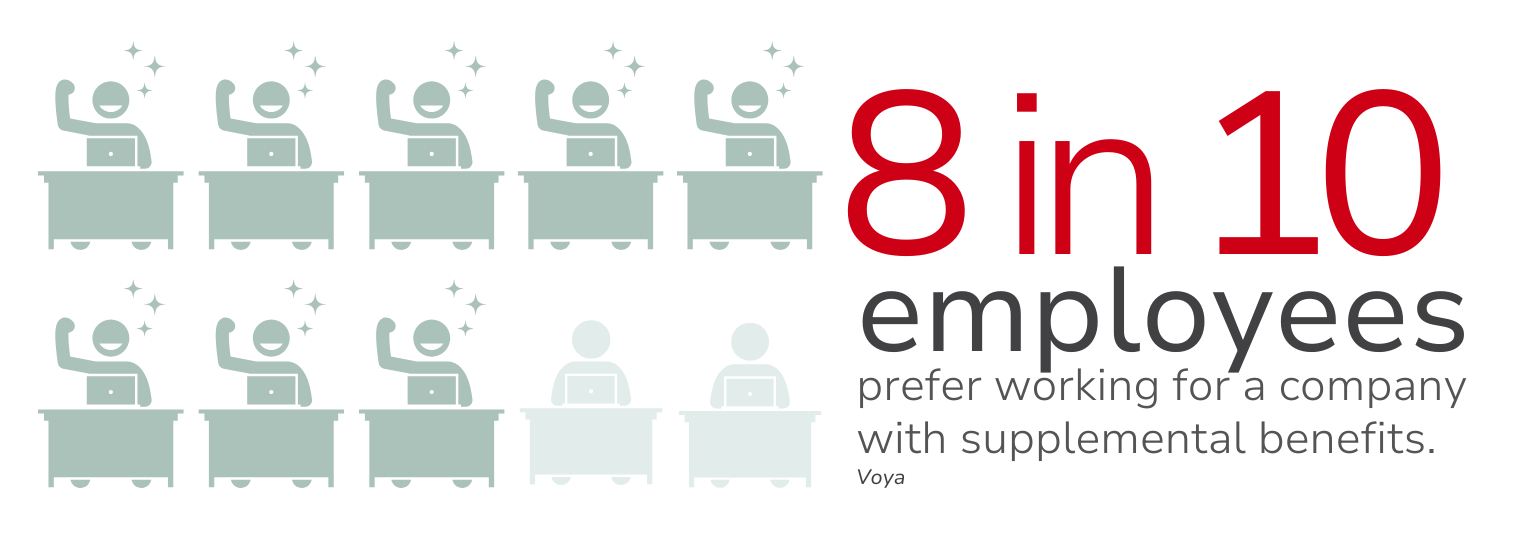
It is no surprise that in
Voya’s 2024 survey, most workers said they would be more likely to choose an employer offering options like accident, hospital indemnity, and critical illness insurance
Why employers should care
When people are worried about medical bills, it affects everything from how focused they are at work to how often they call in sick and even whether they stay in their job. Studies show financial stress is linked to lower productivity and higher turnover.
Offering supplemental benefits can ease that stress. It is a way of saying, “We know unexpected things happen, and we have your back.” That message matters. Employees who feel supported are more engaged, more loyal, and less likely to look elsewhere.
It is also smart financially. For companies using high-deductible health plans to keep premiums down, supplemental options help employees manage those out-of-pocket costs.
The Kaiser Family Foundation reports that in 2024 the total annual premium for employer-sponsored family coverage averaged $25,572. On average, workers contributed $6,296 toward that premium and employers covered the remaining amount, about $19,276. This reflects a 7% increase year over year, which is why many employers are looking for ways to keep plans affordable without reducing value.
How It Might Work in Practice
It is one thing to talk about the benefits. It is another to see them in action. Let’s take a look at some hypothetical scenarios.
Scenario 1: At a 20-person professional services firm, leadership wants to keep premiums low without making employees shoulder more costs. They add accident and hospital indemnity coverage. In the same year, two employees end up needing those benefits, one after a sports injury and another after an unexpected hospital stay. The payouts help them cover bills quickly and reduced time away from work.
Scenario 2: A mid-sized manufacturer takes a different route, offering voluntary critical illness coverage. When one employee is diagnosed with cancer, the lump sum helps cover travel to a treatment center and extra childcare at home. That story spreads, and the next year, enrollment jumps.
Scenario 3: Even in larger organizations, supplemental benefits make a difference. At a tech company with over 500 employees, a young engineer suffers a heart attack. His critical illness plan pays a lump sum that allows him to take a longer leave to recover without worrying about missed mortgage payments. His manager later shares that knowing the company offered that kind of help made the whole team feel more secure.
Clearing up supplemental insurance myths
One of the biggest myths is that supplemental health insurance is redundant. It is not. It is built to cover things your primary plan does not and to do it in a way that is simple and quick.
Another myth is that it is just for big companies. In reality, small businesses can see huge value because they can add these protections without overhauling their entire health plan.
And while cost is always a concern, many supplemental options are surprisingly affordable, especially when offered as voluntary benefits. Employees get to pick what works for them, and employers do not have to foot the entire bill.
Making it work for your team
Rolling out supplemental health insurance does not have to be complicated. Start by asking employees where they feel most exposed such as hospital stays, accidents, or serious illnesses. Then choose a few options that address those needs.
Focus on communication. Skip the jargon and provide examples of how the coverage works in real life. Instead of saying, “Hospital indemnity plans pay a per-day benefit for inpatient care,” say, “If you are in the hospital for five days after surgery, this plan helps pay for those extra costs your main insurance does not cover.”
Use short videos, simple one-pagers, and live Q&A sessions during enrollment. After launch, check in to see how many people are signing up and whether they feel more secure with the benefits in place.
Measuring the difference
You will know it is working if enrollment is healthy, employees give positive feedback, and you start to see fewer cases of delayed care. Over time, these programs can even reduce absenteeism and turnover.
Research shows that organizations offering well-communicated health strategies often improve employee health without increasing costs and sometimes even lower overall spending.
Final thoughts
Supplemental health insurance is not about replacing what you already have. It is about strengthening it. It is an affordable way to show employees you care about what happens when life does not go as planned.
In a competitive job market, benefits like these can set you apart. Start small, explain them clearly, and let the results speak for themselves. The trust and loyalty you build might be the biggest return on investment of all.
Have questions about HSAs or direct primary care? Let’s talk.
Explore
SUGGESTED FOR YOU